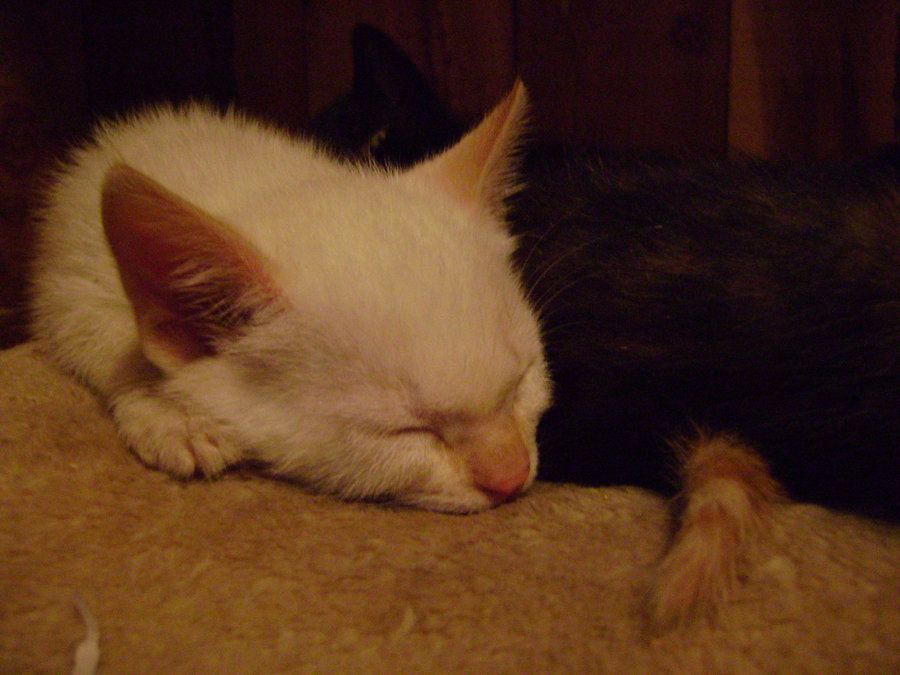
-
Too many ads? Join our community of cat lovers now to reduce ads by 90%! Click here to join for free!
What is the most common color/marking combination for a Domestic Shorthair?
- Thread starter punchy71
- Start Date

I don't know about most common... Here's a list in no specific order:
Grey/Brown/black tabby
tabby and white
black
black and white
red tabby (yellow)
red and white
Calico
Color pointed
blue (smokey grey)
Basically any color pattern a cat can come in, you will find in the domestic short haired variety. Most people commonly associate them with the tabby though... I don't know if it is more common or just the most associated color?
Grey/Brown/black tabby
tabby and white
black
black and white
red tabby (yellow)
red and white
Calico
Color pointed
blue (smokey grey)
Basically any color pattern a cat can come in, you will find in the domestic short haired variety. Most people commonly associate them with the tabby though... I don't know if it is more common or just the most associated color?




Based on the cats I know, I'd say "plain brown tabbies" are the most common. Followed by tortoiseshells, I think.
So I counted up the cats I know, and of the 40 I could think of (belonging to friends and family, and me of course) I came up with 14 brown/gray tabbies (with or without white) and 10 torties/calicos. Seems like a decent percentage.
So I counted up the cats I know, and of the 40 I could think of (belonging to friends and family, and me of course) I came up with 14 brown/gray tabbies (with or without white) and 10 torties/calicos. Seems like a decent percentage.
I think it really depends on the area, too? I see a lot of tabbies... Brown, grey and red mostly... And a lot of solid black cats or black and white seems to be the most popular in my area. I don't see a lot of calicos, mostly solids, bicolors or colorpoints if not a tabby.

It depends a bit where you are, but I'd say that tabby is commonest, followed by black. Both can have white. Blue is quite common, but a colour-point non-pedigree? Someone has let a Siamese or similar out...
Not necessarily, they can have colorpoints and not be related to a simese. Just have 2 moggie parents that are color point carriers.It depends a bit where you are, but I'd say that tabby is commonest, followed by black. Both can have white. Blue is quite common, but a colour-point non-pedigree? Someone has let a Siamese or similar out...

In my area (meaning the whole country)
Brown (black) tabbies
Blue tabbies
Red tabbies
Torties
Solid black
Solid Blue
Solid Red (hard to tell apart from a red tabby though)
And all of the above with or without white, amount of white also can be pretty much anything.
Brown (black) tabbies
Blue tabbies
Red tabbies
Torties
Solid black
Solid Blue
Solid Red (hard to tell apart from a red tabby though)
And all of the above with or without white, amount of white also can be pretty much anything.
But where did the colour point come from? It arose in the far East, I reckon that any moggie that is carrying in the UK it has a colourpoint pedigree somewhere in it's background. AFAIK the markings on the first Siamese were entirely novel cats.
Haha no... It may be a cousin to a Simese or other Oriental, but it does not require a Simese to get out and breed with a DSH any longer... I know this because my friend bred her cats (no Simese blood in them) but they did come from a Ragdoll bloodline and they had Color Point kittens that were considered just DSH's.But where did the colour point come from? It arose in the far East, I reckon that any moggie that is carrying in the UK it has a colourpoint pedigree somewhere in it's background. AFAIK the markings on the first Siamese were entirely novel cats.

As I understand, the original domesiced wild african cats, Felix Lybica, ancestor of all our cats, they were tabbies. And so tabbies is the most common pattern.
As to the colorpoint. Yes, at SOME time there must have been a siamese or burmese (burmese point gene is not the same as siamese) , ( later on, any other colouor point breed, like ragdoll etc).
But this dont need to be near ancestry nor near in time!
The gene as such is "indenpendent" and wanders down [edited typo] the river of the life... So if it happens two different gens of say siamese point gene meets, one form ma, one from pa, voila!
In a litter of several kittens one or two will be point... Perhaps 20 generations after the meeing with the noble siamese ancestor
Such is happening now and then in the russian blue, as they had some blue masked siamese studs between 1945-50 in the breeding programme... And still, now and then, in a litter of beautiful, pure bred, pedigreed russian blue kittens, there may be one or two siblings who looks alike old type siamese... There was even a time they could be registered as siameses, back in the 50:ies and beginning of the 60;ies...
As to the colorpoint. Yes, at SOME time there must have been a siamese or burmese (burmese point gene is not the same as siamese) , ( later on, any other colouor point breed, like ragdoll etc).
But this dont need to be near ancestry nor near in time!
The gene as such is "indenpendent" and wanders down [edited typo] the river of the life... So if it happens two different gens of say siamese point gene meets, one form ma, one from pa, voila!
In a litter of several kittens one or two will be point... Perhaps 20 generations after the meeing with the noble siamese ancestor
Such is happening now and then in the russian blue, as they had some blue masked siamese studs between 1945-50 in the breeding programme... And still, now and then, in a litter of beautiful, pure bred, pedigreed russian blue kittens, there may be one or two siblings who looks alike old type siamese... There was even a time they could be registered as siameses, back in the 50:ies and beginning of the 60;ies...
Last edited:
My lilac point BSH
 and seal silver shaded point BLH both have SIA in their pedigrees if I go back enough, I think it was around '40s-'50s when they introduced colorpoint PER and from them the Brits got the point gene. At least that's what the pedigrees show, quick check shows SIA 20 generations back, Chartreux 10 generations back and few RUS too. Persians obviously throughout the pedigrees pretty much 'til the 80's.
A clip from UCDavis explaining stuff about SIA and BUR colorpoints:

A clip from UCDavis explaining stuff about SIA and BUR colorpoints:
The Tyrosinase (TYR) gene, also known as the Color gene, produces an enzyme that is required for melanin production. Mutations in TYR have been associated with temperature-sensitive pigment production that results in colors known as Burmese and Siamese. The wild type phenotype is full color. The Burmese phenotype results from reduced pigment production changing black pigment to sepia and red to cream. The Burmese points are darker than the body and the eyes are yellow-gray or yellow-green. The Siamese phenotype reduces pigment production to the points and the eyes are blue. The wild type (C) allele is dominant to Burmese (cb). Burmese is incompletely dominant to Siamese (cs); Burmese and Siamese heterozygotes (cb/cs) are intermediate in color (mink).These tests identify carriers of Burmese (also called sepia) and Siamese pointed coloration.
A very rare allele of TYR produces an albino phenotype with white coat and blue eyes. The current tests do not detect this rare form.

In my area (lower midwest) there are a lot of:
Brown tabbies
Orange tabbies
Black - Black/White
Tortoiseshells
During my rescue work in Joplin, MO I noticed that there is a LARGE number of colorpoint strays/ferals and owned DSH/DLH pets. Many more lynx point than I've ever seen and also a large number of snowshoe and ragdoll look alikes in the strays. Makes me wonder if some BYB cats got loose, were turned loose, or sold unspayed, etc.
Brown tabbies
Orange tabbies
Black - Black/White
Tortoiseshells
During my rescue work in Joplin, MO I noticed that there is a LARGE number of colorpoint strays/ferals and owned DSH/DLH pets. Many more lynx point than I've ever seen and also a large number of snowshoe and ragdoll look alikes in the strays. Makes me wonder if some BYB cats got loose, were turned loose, or sold unspayed, etc.

Where I live, black cats and tabbies are the most common. All the common tabby colors are fairly common but I'd say brown tabbies are most common.
I've found some interested colors/patterns in the feral cat population around here... A friend and I rescued a stray cat who was a longhaired orange(red) female that had been hanging around in the neighborhood for a while. She turned out to be pregnant and she had 6 kittens, all shades of red (red,orange, or cream), half females and half longhairs. This means as a stray she somehow found a stray male who was also red (or carried red? not 100% sure on the genetics there) and who probably also carried longhair trait.
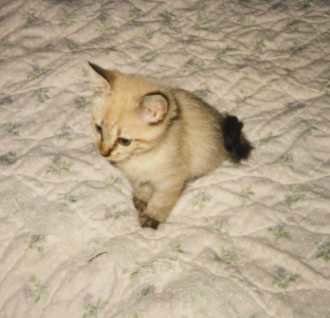
Another friend rescued a litter of feral kittens and gave them to me to raise. One was orange, one brown tabby and the third was lynx point... As far as I know there were no Siamese running around the neighborhood.
Then a few years ago I rescued another litter of feral kittens. They weren't that unusual being all basically brown tabbies and torbies (some with white, some without) except that half of them were ticked tabbies/torbies. I didn't realize it at the time but apparently ticked tabbies are not very common in the DSH population.
Here's a photo of the lynx point feral kitten, Nala:
Her brother and sister:
(the big bellies were because I'd just bottle-fed them)
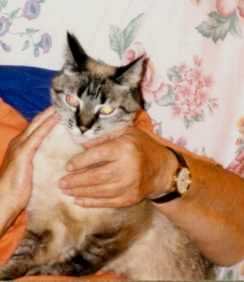
Nala as an adult:
I've found some interested colors/patterns in the feral cat population around here... A friend and I rescued a stray cat who was a longhaired orange(red) female that had been hanging around in the neighborhood for a while. She turned out to be pregnant and she had 6 kittens, all shades of red (red,orange, or cream), half females and half longhairs. This means as a stray she somehow found a stray male who was also red (or carried red? not 100% sure on the genetics there) and who probably also carried longhair trait.
Another friend rescued a litter of feral kittens and gave them to me to raise. One was orange, one brown tabby and the third was lynx point... As far as I know there were no Siamese running around the neighborhood.
Then a few years ago I rescued another litter of feral kittens. They weren't that unusual being all basically brown tabbies and torbies (some with white, some without) except that half of them were ticked tabbies/torbies. I didn't realize it at the time but apparently ticked tabbies are not very common in the DSH population.
Here's a photo of the lynx point feral kitten, Nala:
Her brother and sister:
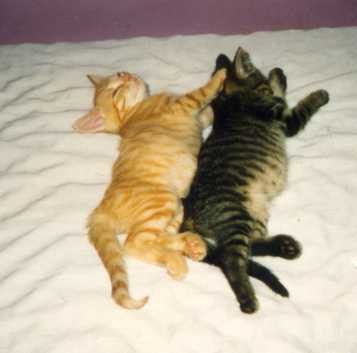
(the big bellies were because I'd just bottle-fed them)
Nala as an adult:

- Joined
- Jan 28, 2012
- Messages
- 162
- Purraise
- 12
I found this all very interesting because I found a stray tortie who had a litter of 7 (pregnant when i found her). Three black, two tortie, one ginger tabby, and one flame point. I wondered what that was all about.