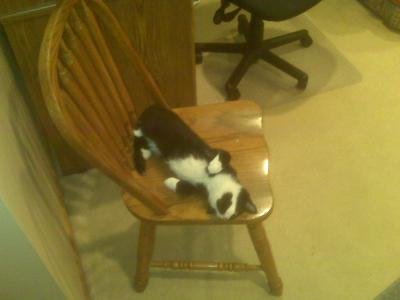
Welcome to TCS! And welcome to the world of loving kitties!

DH used to HATE cats - until one adopted us. They have a way about them..... they worm their way straight into your heart. I love dogs too - but they are
completely different animals! You'll find all those cute little messages to be so true.... (things like "Dogs have owners, cats have staff," and "Dogs come when called, cats take a message and get back to you...."

).
As to your question - those are definitely expensive prices. I don't know if they're expensive for the area though, you know? We live in rural NJ, and a regular neuter with all you mentioned (not the laser) is $90 and a regular spay is ... $120. Wait - that doesn't include the pre-anesthetic blood work. That is $40 (done just to make sure there's no reaction to the anesthetic. A regular full blood panel is around $170 I think. That, for some reason, is expensive out here).
Your kitten definitely needs to be treated with Revolution. There are a lot of anti-flea and tick and internal parasite meds. You should know that you should NEVER use over-the-counter meds by Hartz or Sargents or whatever - they do not work and may kill your cat.

Revolution I think can now be purchased from places like Petsmart without a scrip, so I guess that's confusing - but Advantage and Revolution are not in the same class as flea collars or other treatments. Advantage only treats fleas. Both are topical (you put on the skin of the cat (spread the hair) between the shoulder blades), but Revolution also treats (the common) internal parasites. I would find out from the vet how old the kitten is before treatment, however, and make sure it's OK to use. I don't remember if there's an age thing on treatment with Revolution or not (we tend to work with older ferals). Revolution will kill fleas, flea eggs, ticks, and round worm (internal parasite). These are all very common in rescue cats.
Again, I don't know how old kitty needs to be for vaccinations, but if he's seven weeks old or 2 pounds or more, it is safe to neuter him (or spay her). Some vets won't do it because they're not used to working on such small animals, but the research is out there and it does not affect the cat (other than in beneficial ways) long term.

If your vet wants to wait until four months (when they teethe) or six months (standard), it's OK.
I don't recommend any vaccinations other than the regular rabies (required by most states) and distemper. There was a problem with sarcomas developing at the site of the rabies injection over time, so there is now a new vaccine for it called PureVax that is safer. It requires an annual booster shot (the old one was every three years after the first year follow-up), but it safer for your cat long term. Distemper is given twice - the follow-up will be three weeks after the first one. We give distemper vaccinations the first year, and then after that the only vaccine we give to our indoor-only cats is the rabies. We work with ferals outside, so we're just careful about bringing anything in with us.
Don't let the vet talk you into the Feline Leukemia Virus (FeLV) or Feline Immunodeficiency Virus (FIV) vaccines. FIV has several strains, and it's effective in TX and other areas in the South. I don't know about MN, but as you're not going to be working with ferals and your cat will be indoor only, there is just no need for either. Also, there is absolutely no point in testing for FIV before the cat is six months old. If mom was infected with FIV, the kitten will have antibodies from the milk and test positive, but this does not mean kitty is infected with the virus. So don't bother with that test. We do test for FeLV. If he/she is positive, it is not necessarily a death sentence, and shouldn't be. It just means that if you adopt any other cats, it's best if they've got FeLV. In fact, many kitties with FeLV need homes.

As to the rest, I'm going to share stuff I'd wish I'd known when we rescued our first kitty.

Cats can get bored easily with their toys. You don't have to keep providing new ones. Circulate them weekly.

Kittens have a LOT of energy and need a lot of attention, they're just like little children. You have to use up as much energy as you can, and you have to teach them what's right and what's not OK.
It is just as important (if not more important) to praise them for being good, and for playing right, as it is that they learn the word "no." To say "no" to a cat, blow a short, sharp puff of air right in his face and say "no" firmly but not loudly. They'll learn "no," and they understand that puff. Humans don't hiss well.

Your kitten will start teething around four months old. They become very bitey at this stage. It is best, if from the very beginning, you teach your kitty that humans are not toys. Do not play with your hands, your fingers, your arms, your feet - just don't. I know it's fun, but when those adult teeth are coming in, it is not nearly as cute. DH still sometimes plays with his hands, and always ends up getting hurt with a sharp claw if I haven't clipped recently.

Human limbs are not toys! The best chew toy during this phase are plastic bendy straws. Have lots on hand, scatter them everywhere, and when kitty goes to bite you, hand him a straw. Praise the heck out of him for using them.
Wet food, though more expensive, is better for your cat. Male cats in particular can have problems with blockage of the urethra. This can kill them within 24-48 hours. If you ever see your cat pee outside of the box, MOST of the time it is a health problem and it means they need to go to the vet. Some cats definitely stress pee, but a health problem MUST be ruled out. One of our cats pees outside of the box when her teeth hurt. She has bad dental problems, and even with brushing her teeth (which she loves BTW), she has to go to the vet every six months for a dental cleaning.

Anyway, the point is, wet food helps keep the urine dilute. This is the goal. We have water fountains and water dishes out everywhere. We let the cats free feed on dry food, but we provide a wet meal in the morning and at night, and we mix a little warm water in with the wet food. The more water you can pump through your cat, the better for his long term health.

We like the mix of wet and dry, because the dry is good for their teeth.
If I think of other stuff, I'll add. But those were the basics that jumped to mind.

And, of course, TCS is here for any and all questions you have along the way!
BTW - we do love pictures.